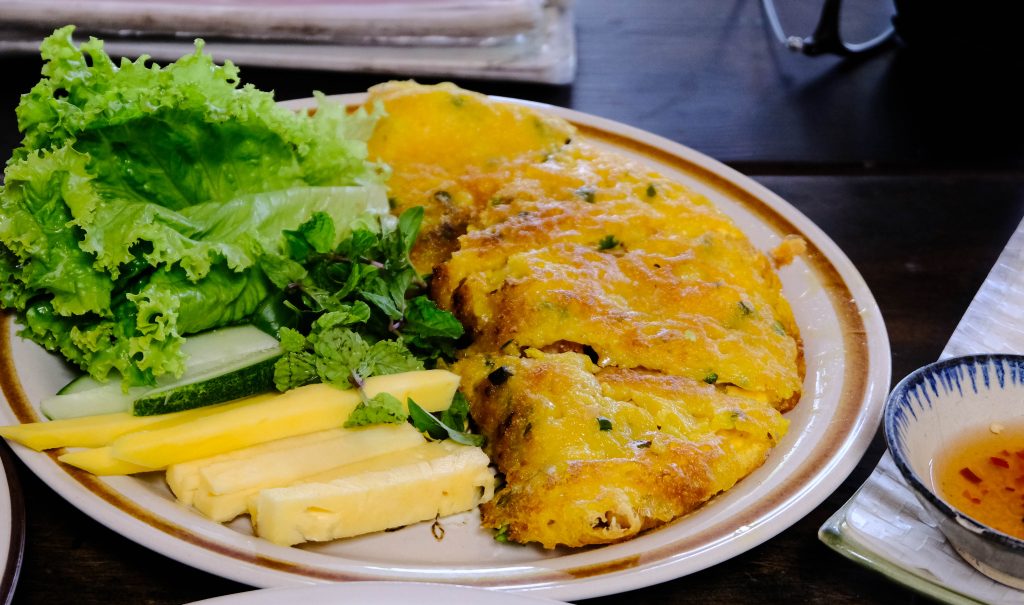
Banh Xeo is a popular dish throughout Vietnam. In Vietnam, there are 3 main regions: North, Centre, South. Each region has its own Banh Xeo. Some prefer the crunchy Banh Xeo, some like the soft Banh Xeo. The filling also depends. The main filling is shrimps and pork. However, in some cities like Hue, they use fish for the filling inside.
Banh Xeo in Hoi An is another version. It is crunchy on the outside and soft on the inside. When we eat, we wrap it in the rice paper with lots of herbs and vegetables. With this version, the Banh Xeo should be very crispy and less oily. We call that "Yin and Yang" Philosophy in Vietnamese cuisine. It should be the balance between fresh and cooked, starch and protein, meat and veggies.
When eating, we wrap it inside a rice paper with herbs and vegetables, then dip it into the sweet and sour fish sauce.
Currently, there is no specific scientific evidence that can pinpoint the exact origin of Hội An's bánh xèo. However, historical and cultural information suggests that it is a result of a cultural fusion between the Vietnamese and Cham people. There are also suggestions that bánh xèo was introduced to Vietnam through Faifo Port, a bustling commercial port in Quảng Nam during the 17th and 18th centuries. Faifo Port was a destination for many merchants and visitors from different countries, including Japan, China, and India. This cultural exchange contributed to the diversity and richness of the local cuisine, including bánh xèo.
Accordingly, bánh xèo is believed to have drawn inspiration from countries with rich culinary traditions:
- Japan: Some believe the round shape and golden color of bánh xèo may have been influenced by the Japanese dish okonomiyaki, a savory pancake filled with shrimp, meat, and vegetables.
- China: Hội An's bánh xèo could also have been influenced by the Chinese dish jianbing, a thin crepe made from flour and filled with meat and eggs.
- India: The spices and the use of fresh herbs in bánh xèo may have been influenced by Indian cuisine.
By inheriting these culinary essences, the people of Hội An have adapted the traditional bánh xèo in their own unique way, creating a distinctive flavor. Hội An's bánh xèo has a smaller size compared to versions from other regions, with a crispy, golden-yellow crepe made from rice flour. The filling is rich and diverse, including shrimp, meat, bean sprouts, and mushrooms. Hội An's bánh xèo is served with various fresh herbs and a special dipping sauce.